
- Legal entity: Dongguan Zhuohang Ltd, brand Zhuohang Precision Machining Factory, registration 91441900MA4UWT6X39.
- Founded 2005, in Hengli Town, Dongguan, Guangdong — the Pearl River Delta.
- 6,800 m², 100+ people, over a hundred machines — one building for production, one for dormitories and dining.
- ISO 9001 + IATF 16949 + ISO 14001, held by the entity that invoices.
Why does the entity behind the brand matter?
In cross-border machining, the brand is marketing and the entity is law. The name on the website can be anything; the name on the certificate and the invoice is who actually owes you the quality. If you audit the brand but not the entity, you have audited a logo.
That is why this page states the entity the way an auditor would want it: legal name, registration number, founding year, physical address, and the certificates that entity holds. Every item is checkable against a public registry or a registrar.
The reason this item leads the factory audit is that it is the load-bearing wall. If the entity checks out, the rest of the audit — the floor, the machines, the certificates — has a legal owner. If it does not, everything downstream sits on an untraceable name, and a dispute has no one to chase.
Who is the legal entity?
The entity is stated the way a due-diligence checklist wants it, field by field, so it can be matched against the public record without ambiguity.
| Field | Value |
|---|---|
| Legal name | Dongguan Zhuohang Ltd |
| Brand / trading name | Zhuohang Precision Machining Factory |
| Site name | China CNC Machining |
| Registration No. | 91441900MA4UWT6X39 |
| Established | 2005 |
| Former names | Dongguan Zhuohang Ltd; Zhuohang Precision Machining Factory |
Match check: the same entity — Dongguan Zhuohang Ltd — holds the three certificates below and sends the invoice. That match, verified against the registrar, is the single most important entity check you can run.
Former names are disclosed here for a reason: a company that changes its legal name should be able to explain the trail. If you find a prior name on an old certificate, you should not treat it as a red flag on its own — only as a thread to pull. The test is whether the current entity can reconcile its history, not whether it has one.
Where is the factory, and why does location matter?
The factory sits at No. 8, Shuibian Songyuan Road, Hengli Town, Dongguan, Guangdong, China 523470 — in the heart of the Pearl River Delta. That geography is not incidental to quality and lead time; it is part of the process.
The Delta is the densest CNC and consumer-electronics supply chain on earth. A factory there can source a certified billet, a cutting tool, and an anodizing line within a day's drive, which is why a part moves through the process in days rather than waiting a week on a truck between operations. Location is an audit item, not a footnote.
The second-order effect is resilience. When a material grade or a tool is a day away rather than a week away, a supply hiccup is an inconvenience, not a production stop. A buyer auditing location is really auditing lead-time risk: the shorter the supply loop, the fewer the single points of failure between the order and the dock. The coordinates — 23.048947, 113.990605 — pin the address to a map, which is the difference between a stated location and a checkable one.
How large is the facility and the team?
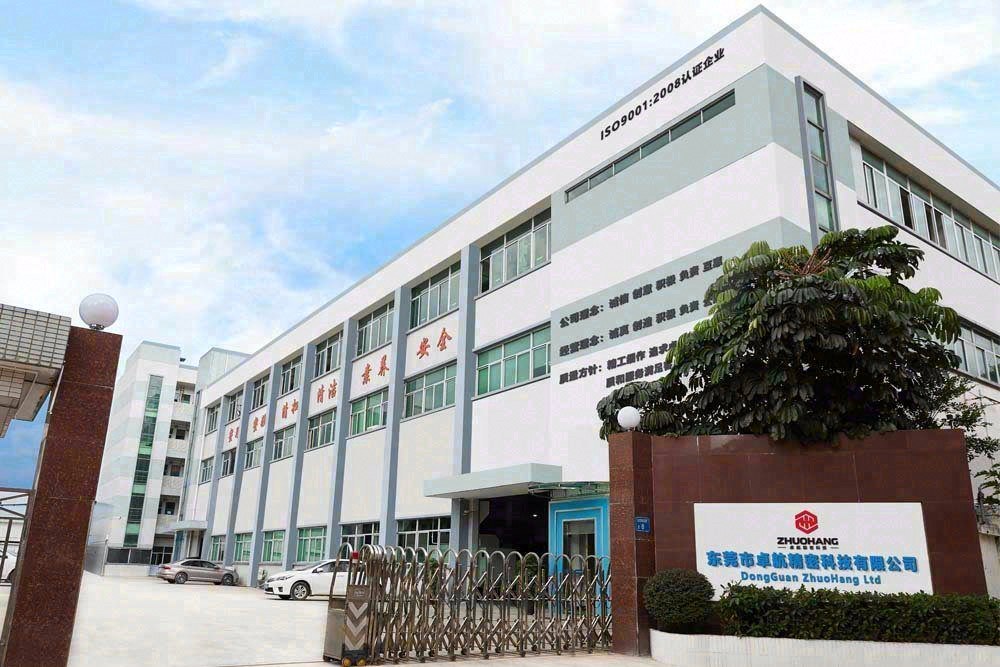
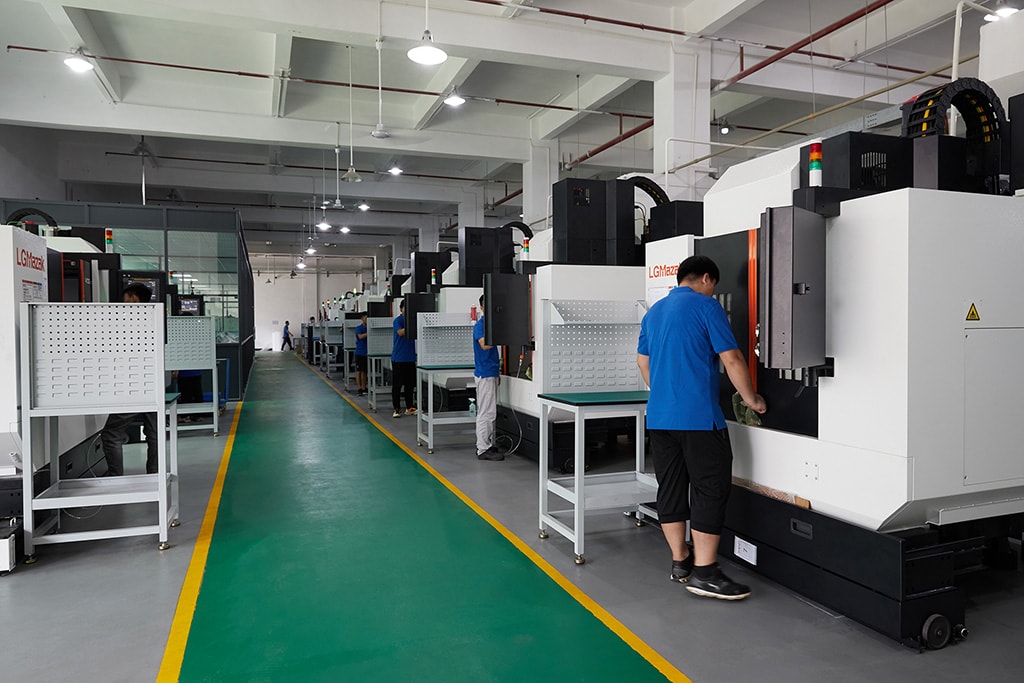
Capacity is audited against physical reality, not headcount bravado. The campus is two buildings: one for production, inspection, and offices; one for employee dormitories and dining. The production side holds over a hundred machines across 6,800 m², run by 100+ people, with a skilled-technician share of 80%+ and 60% of employees holding five to ten years of experience.
The two numbers that matter most here are not the square meters but the experience split. A floor with 80%+ skilled technicians and 60% of staff in the five-to-ten-year band has already absorbed the cost of the mistakes a junior floor makes on your order — the misread datum, the missed offset, the inspection pass that should have been a fail. When you audit a team, that experience mix is what you are actually buying.
Which industries does the factory serve?
The industry list is part of the entity audit, because it tells a buyer whether the shop has seen their kind of part before. This factory serves automotive, robotics, electronics, medical, and automation machinery and equipment. The IATF 16949 certificate reflects automotive-grade process control — SPC, PPAP, FMEA, and traceability — and that discipline carries across to every other industry, not just the automotive programs.
| Industry | What the shop has learned to do | What carries over to your part |
|---|---|---|
| Automotive | PPAP, SPC, FMEA, full traceability | Process control and documentation discipline |
| Robotics | Tight fits on joints and housings | Repeatability and assembly tolerance |
| Electronics | Small features, burr control | Clean edges and small-hole capability |
| Medical | Material certs, batch isolation | Lot discipline and cleanliness |
| Automation machinery | Mixed-part programs, assembly | Multi-part kits delivered as sets |
How is the company's conduct governed?

An audit of the entity should extend past the machines to the conduct behind them. The company operates under a documented code of conduct covering legal compliance, anti-forced-labor and anti-child-labor commitments, environmental responsibility under ISO 14001, anti-bribery and fraud, confidentiality and data protection, health and safety, and supplier responsibility. Labor contracts are signed on joining, social insurance is provided to all employees, and working hours follow labor law. Customer IP is protected — sensitive paper in secured storage, electronic data on encrypted drives.
Why this belongs in the entity audit: a supplier that cuts corners on labor or the environment is, in your position, a compliance liability in waiting. The governance record is the soft half of the hard certificate. ISO 14001 already puts environmental management on the audited list; the code of conduct extends the same "documented and checkable" logic to labor, safety, and data.
The check is not to read the policy — every website has a policy. The check is to ask for the evidence behind it: the signed labor contracts on file, the social-insurance enrollment, the data-handling procedure. A policy is a sentence; the evidence is the audit.
How do you verify this entity before ordering?
Do not accept this page as settled — check it. Three moves verify the entity in minutes: confirm the registration number against the public registry, verify the certificate numbers with the registrar, and request a live video walk-through matched to the physical address. A real factory welcomes all three; a trading desk deflects. The response to that request is, in practice, the sourcing decision already made.
Each check tests a different layer. The registry check tests the legal existence; the certificate check tests the quality system; the walk-through tests the physical reality. A supplier that passes the first two but dodges the third has told you it is a desk with good paperwork. A supplier that passes all three is what the brand claims to be.
How do you verify a Chinese registration number?
The registration number 91441900MA4UWT6X39 is the entity's fingerprint in the public record. The check is straightforward: query the number against the public business registry and confirm three things — the legal name comes back as Dongguan Zhuohang Ltd, the status is active, and the registered address matches the one on this page and on the invoice.
The number itself is structured, not random. The leading digits encode the registration authority and the region, and the suffix is unique to the entity, so a mismatch between the number and the name is caught immediately. You do not need to be a China specialist to run the check — the registry query is public, and a legitimate supplier will point you to it rather than away from it.
The point of this step is to anchor everything else. The certificates and the invoice both hang off the legal entity; if the registration number checks out, the entity is real and the rest of the audit has a foundation. If it does not, no certificate in the world fixes the problem.
Why does the team's experience change the audit?
Machining is a craft disguised as a manufacturing process. The tolerance on the print is held by a person who reads the setup, watches the tool wear, and catches the drift before it becomes scrap, and that judgment is bought with years, not months. The experience split on the floor is therefore an audit item as real as the machine list.
Here the numbers are stated plainly: 80%+ of the team are skilled technicians, and 60% of employees hold five to ten years of experience. What that means for you is a floor that has already made the expensive mistakes on someone else's order — the misread datum, the missed offset, the inspection pass that should have been a fail. A junior floor learns those on your dime; a seasoned floor prices them in already.
The audit question is not "how many people" but "how many years, on average, stand behind the part." Ask it, because the answer is the difference between a tolerance that holds on the demo and a tolerance that holds on the thousandth part.
What documents should you collect for the entity audit?
The entity audit closes as a short paper trail, because that is what due diligence actually produces. Before you commit, collect each of these and file it:
- The registration record — the public registry entry matching 91441900MA4UWT6X39 to Dongguan Zhuohang Ltd, status active.
- The certificate numbers — 116024/A/0001/UK/En, 131941/A/0001/SM/En, and 116024/B/0001/UK/En — verified with the registrar URS.
- The address and coordinates — No. 8, Shuibian Songyuan Road, Hengli Town, Dongguan, Guangdong, China 523470, at 23.048947, 113.990605, confirmed on a map.
- The walk-through recording — a live video call that shows the running floor matched to the written machine list.
- The contact record — [email protected], +86 13126536955, with the languages the desk works in.
With those five documents on file, the entity half of the audit is closed, and you have a legal owner for every claim that follows. That is the point of this page: the brand is a story, but the entity is a fact you can hold.
What this shop actually runs
Capability evidence should come as specifics, not slogans. Behind this guide is a 6,800 m2 plant in Dongguan, China running 100+ CNC machines with 100+ staff. The machine list by category:
- 5-axis machining centres (10+) - Mazak VARIAXIS I-600 (510/910/510 mm travel, 12,000 rpm, 22 kW, 71.6 N·m, 30-tool BT40) and Mazak INTEGREX I-250H S (B-axis 0.0001°, 24 kW, 124 N·m, 38-tool HSK-A63). Made for compound-angle parts, single-setup multi-face prismatic work, and aerospace fittings where datum transfer loss is unacceptable.
- 3-axis / 4-axis machining centres (50+) - Brother SPEEDIO S500Z2N / S700Z2N (10,000 rpm, 14/21-tool ATC, 0.7 s tool-to-tool, Z-axis 2.2 G) and Mazak VCE-430A L / VCE-570C L (10,000 rpm, 118 N·m, 24-tool ATC). Made for prismatic parts, plates, brackets, housings.
- Swiss-type turning centres (10+) - Citizen Cincom A20-3F7 (Φ20 mm, 10,000 rpm), TSUGAMI B0206-III / B0205-III (Φ20 mm, 0.1 µm), STAR SR-32JII / SR-32J Type N (Φ32 mm, 8,000 rpm). Made for long, slender rotational parts at ±0.002 mm.
- CNC turning centres (20+) - HEADMAN T70M/1250 (720 mm swing, 117 mm bore, 3,000 rpm, BMT75 12-station turret). Made for shafts, bushings, flanges up to ±0.002 mm.
- Wire EDM (5+) - Sodick AQ535L (550/350/300 mm travel, ±20° taper, 800 kg workpiece). Made for hardened tool steel, internal splines, sharp internal corners that milling cannot reach.
- Inspection: Hexagon CMM + 20+ gauges - Hexagon CMM for coordinate measurement, plus vision system, profilometer, hardness tester, coating thickness gauge, XRF for material verification. The 10:1 rule (gauge 10x more accurate than the band) is applied to every feature.
- Machine highlights - VARIAXIS I-600: one-setup multi-face 5-axis + MAZA-CHECK auto-calibration; INTEGREX I-250H S: DONE-IN-ONE mill-turn, B-axis 0.0001° + Ai thermal shield; SPEEDIO S500Z2N / S700Z2N: Z-axis 2.2 G + 0.7 s ATC; Swiss-type: guide-bush switchable + 0.1 µm resolution.
Tolerance: ±0.003 mm CNC milling / ±0.002 mm CNC turning / ±0.002 mm grinding and wire EDM. Capability: Ppk >= 1.67 initial on key characteristics, Cpk >= 1.33 ongoing.
Certificates: ISO 9001:2015 (116024/A/0001/UK/En), IATF 16949:2016 (131941/A/0001/SM/En, with design clause 8.3 excluded, stated openly) and ISO 14001:2015 (116024/B/0001/UK/En), issued to Dongguan Zhuohang Ltd, registration 91441900MA4UWT6X39, founded 2005.
Where we ship: Austria, Belgium, the Czech Republic, Denmark, France, Germany, Greece, Hungary, Ireland, Italy, the Netherlands, Spain, Sweden and the United Kingdom in Europe; Brazil, Canada, Mexico and the United States in the Americas; China, Israel, Japan, Singapore and Sri Lanka in Asia; Australia and New Zealand in Oceania; and South Africa in Africa — plus other countries and regions worldwide, shipped from our base in Dongguan, China.
Contact: Felipe Iglesias, [email protected], +86 13126536955.
Verify the entity before you trust the brand.
Contact [email protected] or call +86 13126536955 for the certificate numbers, a live walk-through, and the documents behind this page.
Frequently Asked Questions
Who is the legal entity behind China CNC Machining?
In short, Dongguan Zhuohang Ltd, trading as Zhuohang Precision Machining Factory and Zhuohang Precision Machining Factory, registration No. 91441900MA4UWT6X39, established in 2005.
Where is the factory located?
At No. 8, Shuibian Songyuan Road, Hengli Town, Dongguan, Guangdong, China 523470, in the Pearl River Delta — half a day from Shenzhen's port and a day from the tooling and material suppliers that feed the machining floor.
How large is the facility and team?
The facility covers 6,800 m² with 100+ employees and 100+ production machines plus 20+ inspection instruments. The campus is two buildings — one for production, inspection, and offices, and one for employee dormitories and dining.
When was the company founded?
In short, In 2005. The company has operated under the legal name Dongguan Zhuohang Ltd, with the marketing brand Zhuohang Precision Machining Factory, and previously traded as Dongguan Zhuohang Ltd
Which industries does the factory serve?
In short, Automotive, robotics, electronics, medical, and automation machinery and equipment. The IATF 16949 certificate reflects the automotive-grade process control — SPC, PPAP, FMEA, and traceability — applied to those programs and carried across to other industries.
How can I verify this entity before ordering?
In short, Check the registration number against the public registry, verify the certificate numbers with the registrar URS, and request a live video walk-through of the floor matched to the legal address. A real factory welcomes all three; a trading desk deflects.
Who do I contact for an order or visit?
Felipe Iglesias, the business development contact, at [email protected] or +86 13126536955, in English, Portuguese, Spanish, or French. Factory visits are welcomed, and the GPS coordinates are 23.048947, 113.990605.
How do I verify a Chinese business registration number?
In short, The registration number 91441900MA4UWT6X39 can be checked against the public business registry. The check confirms the legal name, the registration status, and the registered address, so the entity on the certificate and the invoice can be matched to a real, active company.
Why does the team's experience matter to the audit?
In short, Because the tolerance and the certificate mean nothing if the people setting up and inspecting the parts have not done it long enough to catch drift before it becomes scrap. A shop where 80%+ of the team are skilled technicians and 60% hold five to ten years of experience has already paid for the mistakes a junior floor would make on your order.
Continue reading: 3 Axis China CNC Machining · 4 Axis China CNC Machining · 5 Axis China CNC Machining
Standards referenced on this page
- IATF 16949:2016 — Automotive quality management system standard
- ISO 14001 — Environmental management systems — Requirements with guidance for use
- ASTM A582/A582M-12 — Standard Specification for Free-Machining Stainless Steel Bars